Customer Restoration
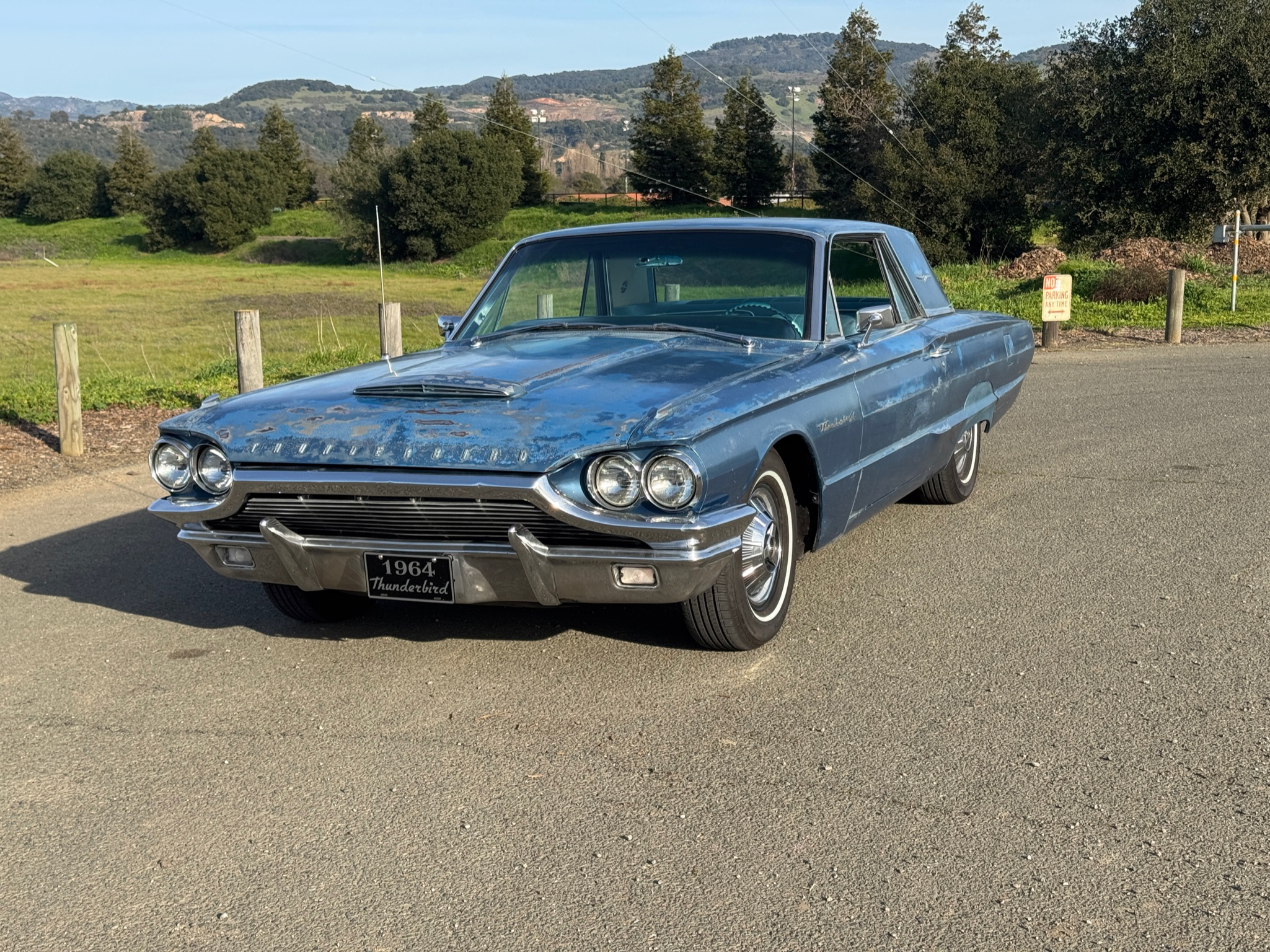
1964 Ford Thunderbird “Jacqueline”
Scope of Work
I was looking for a new project after getting my childhood truck to the point where it was performing exactly as I wanted. While searching eBay Motors, I came across this car—a classic that had been sitting abandoned in a field for more than 15 years. According to the ad, about the only things still working were the headlights and turn signals.
I drove to Sacramento to see the car in person and, after verifying that the engine wasn’t seized, decided there was enough potential to take a chance on her. What I didn’t fully appreciate at the time was just how much work it would take to bring her back. For $1,500, she was mine and soon delivered home, where the process of discovering her true condition began.
It was bad. There was melted wiring, extensive rust, leaking glass, and fender wells packed with years of dirt, debris, and fabric—apparently the work of squirrels that had found themselves a relatively dry place to call home. Every time I removed another part or dug a little deeper, I seemed to uncover another problem. But rather than discouraging me, each discovery made me even more determined to put this car back on the road.
I named her Jacqueline, because the vision from the beginning was that she would eventually become a refined, well-mannered lady. That idea helped set the direction for the entire restoration. Virtually every system and component would need attention—mechanical, electrical, body, interior, suspension, brakes, and everything in between. Nothing would be overlooked, and that was part of what made the project so exciting.
Jacqueline ultimately became much more than another restoration. She helped define the philosophy behind Napa Classic Restos. This is where “Keeping Classics on the Road” came from—although, in Jacqueline’s case, “Putting Classics Back on the Road” might have been even more appropriate.
Ironically, I originally bought Jacqueline for the experience of restoring her, fully intending to sell her when the project was finished. That plan changed once she was back on the road. After I had been driving her around town for a while, Val asked me when I was going to sell her. By then, I had fallen in love with her style, her interior, and the unmistakable class she brought to every drive. I had to admit that Jacqueline wasn’t going anywhere.
Val then asked the obvious question: “Do you really need two?”
My answer was simple: “It could be three.”
And that pretty much sums up how this passion has grown.
Body & Paint
While my '52 Chevy truck is my glamour girl, currently the Thunderbird is my patina queen and I have an incredible amount of time curating the patina of this car. Currently it's about 50/50 for keeping her patina vs a full repaint but my ultimate plan is to restore her to her previous Brittany Blue glory. I painted the engine bay the correct color to start the process and to remind me of what her future glory will look like.
Mechanical
It’s difficult to know where to start with Jacqueline because virtually everything needed attention. The water pump was seized, the timing chain had excessive slack, the alternator was defective, and nearly every mechanical and electrical system required repair, replacement, or upgrading.
From the beginning, my philosophy was simple: build a car I would be proud to hand the keys to my dad and have him drive anywhere with confidence. That philosophy ultimately became the standard I bring to every restoration. Each repair and upgrade needs to be something I am personally proud to stand behind, whether the customer can see it or not.
In fact, some of my favorite work is the work no one will ever see. The wiring hidden behind the dash, properly routed hoses and lines, sealed connections, correct fasteners, and all the small details buried beneath the finished car matter just as much to me as the things everyone notices.
Knowing that no corners were cut is an important part of taking pride in a restoration. And if someone works on one of these cars years from now, I want them to look behind the dash, underneath the car, or inside the engine bay and immediately recognize that the work was done thoughtfully and correctly.
The quality of a restoration shouldn’t end where you can no longer see it.
Electrical
Everything—and I mean everything—needed attention. As I worked deeper into the car, I found melted electrical blocks, trim pieces damaged by overheated cables, and wiring wrapped in electrical tape where the original insulation had completely melted away. Evidence of previous electrical repairs was everywhere, and I became convinced that electrical problems were likely one of the reasons Jacqueline eventually ended up sitting in that field.
At some point, previous owners had clearly been doing whatever they could to keep her on the road, but years of repairs and deteriorating wiring had taken their toll. Rather than continuing to patch an unreliable electrical system, I made the decision to remove the main wiring and start over with a new harness and modern fuse panel.
Rewiring my ’52 Chevy had been relatively straightforward. Jacqueline was an entirely different challenge. By this time, Ford was incorporating more sophisticated electrical features into its luxury cars, including relays, a low-fuel warning system, seatbelt safety features, and numerous other conveniences that made the Thunderbird considerably more complex.
The goal wasn’t simply to replace the old wiring. I wanted to create a safe, reliable electrical foundation while respecting the intentions of Ford’s original designers. Updated wiring, modern protection, and dedicated relays were incorporated for critical components while retaining the functionality and character that belonged in the car.
As with the rest of the restoration, much of this work would eventually disappear behind panels, under the dash, and inside the engine compartment. But that’s exactly the kind of work that matters to me. When the restoration is finished, the electrical system may not be the first thing anyone notices—but knowing what is behind everything, and knowing it was done correctly, is what makes me proud of the finished car.
Chassis / Suspension / Brakes
Steering components were showing their age so replacing was important. On my first long distance drive to the 2026 Kool April Nites show where Jacqueline was to be debuted I was able to further diagnose issues. upon returning the Ford 9" rear end was pulled and rebuilt along with all new rear suspension bushings. I don't put back in rusty bolts, brackets or components on any of my builds so everything was stripped, repainted and all new bushings were installed to insure future performance. New shocks were installed on all corners along with new brakes and components. All new brake lines, fuel lines, gas tank and sender was installed.
Interior
The interior was in rough condition, with rust, deterioration, and years of neglect affecting nearly every component. Ironically, this is one of my favorite parts of any restoration. There is something incredibly rewarding about taking original pieces that have survived for decades and carefully bringing them back to the way they were intended to look and function.
I have no problem incorporating modern upgrades when they improve reliability, safety, comfort, or drivability, but with Jacqueline, preserving the original character of the interior was especially important. Rather than replacing everything with modern components, the goal was to restore as much of the original interior as possible while maintaining the authentic look and feel of the car.
The first order of business was creating a better foundation for the interior. Heat and sound insulation were installed throughout the cabin, followed by a final layer of mass-loaded vinyl to further reduce road noise, vibration, and heat transfer. These improvements are largely hidden once the interior is reassembled, but they make a significant difference in creating a quieter and more comfortable driving experience without altering the car’s original appearance.
The dashboard, gauges, seats, and rear package tray were removed and completely restored. Special attention was also given to some of the Thunderbird’s unique luxury features, including the vacuum-operated rear-window fresh-air ventilation system and the iconic swing-away steering wheel. Both systems were carefully restored to proper operation rather than eliminated or replaced with modern alternatives.
Bringing these original details back to life is one of the most satisfying parts of a restoration. It isn’t simply about making an old interior look new again—it’s about **preserving the engineering, craftsmanship, and character that made the car special in the first place**, while making thoughtful improvements that allow it to be comfortably enjoyed for years to come.
Preservation / Detailing
All dashboard components were stripped, restored, and refinished in the correct factory colors originally specified for the car. The gauges were fully restored, with the original AMP gauge sent to RCC Innovations in Texas to be professionally converted to a voltmeter. This provided more useful monitoring of the modernized charging system while preserving the appearance of the original gauge cluster.
The engine bay was refinished in the car’s original Brittany Blue, while the valve covers, air cleaner, and power steering reservoir cap were restored in the correct gold finish. Careful attention was given to maintaining the original colors and details throughout, allowing the restored components to retain the authentic factory appearance and character of the car.
Work Completed
I have throughly enjoyed continuing to upgrade components on this build. Someone once asked me when she would be done and my reply was Never as there is always something on my mind that I would love to see her get to further the restoration.